


I think of voice work as magic.
And I mean that almost entirely seriously.
How else do you describe the study of a practice that means we can stand before hundreds of people and hold them rapt with one utterance? How with different choices, we can make people fall in love with us, or hate us, or laugh, or gasp? To transform ourselves from a Caliban to a Billie Holiday to a Poirot? To express the ecstasy of adoration by sustaining a high B, or belting out the horrors of hardship? To muster energy from the deepest parts of ourselves, ignite a line of connection, and shake the very world with our vibration and demand to be heard and understood?
Magic, yes, but also technique. Not inherently political, but about helping people find and use their voice, their right to be heard. Deeply personal, but also about our collective ancestral relationship to sound.
While I often joke that there are a lot of hills I’ll die on as a voice person, the biggest is that we all have a right to our voice. A right to be heard. We all have equal ownership over language as part of our universal, collective birthright as members of the human race.

Coaching A Christmas Carol in 2025.
Giving artists an inventory of tools that empowers them with the freedom of choice.
Tools, not rules, pulling from a wide range of experience with different genres and styles, from Shakespeare to musical theatre. By experiencing and training facility with a wide array of choices, we are prepared for whatever the world may throw at us. In fact, I think an eclectic mix of engagement with different genres, concepts, and techniques makes for artists that see all text as heightened text. They’re less constrained by boundaries, and more excited by the similarities to be found in “cross-training.”
My training has largely focused on the voice and speech modalities of Kristin Linklater, Catherine Fitzmaurice, Cicely Berry, Patsy Rodenberg, and Knight-Thompson Speechwork. Other influences I cite as integral to my aesthetic include clown, Alexander Technique, mask work, and Laban Movement Analysis. I am as comfortable working with new works by emerging playwrights as Shakespeare and Greek drama or musical theatre.
As a teacher, I’ve worked regionally with Florida Studio Theatre, Texas Shakespeare Festival, the Clarence Brown Theatre, the University of Tennessee-Knoxville, and the Great River Shakespeare Festival, offering classes and workshops in acting, solo performance, devising practices, and voice, speech, and dialects. I’ve offered workshops and coached 1-on-1 on acting, audition prep/technique, Shakespeare, and voice, speech, and dialects. I’ve also been fortunate to work as a Voice, Text, and Dialect Coach with the Clarence Brown Theatre and Great River Shakespeare Festival, as well as supporting educational theatre productions in East Tennessee.
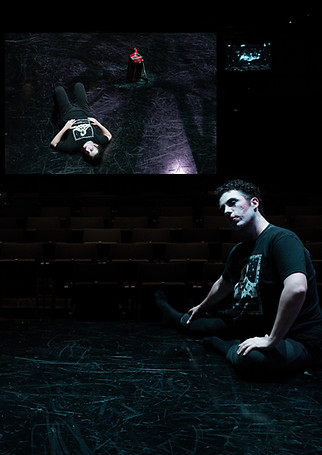
Release work as the Emcee on a 2-show day for Cabaret.
Voice, Text, and Dialect Coaching
Skillful speech work is not only artful, but it is an act of care that invites audiences into our performances. My role as Voice, Text, and Dialect Director/Coach is to assist productions in maintaining vocal health, digging into text work, adopting accents to aid storytelling, and supporting the work of the actor from a Voice & Speech perspective.
Workshops
I offer a variety of workshops aimed at helping artists of all ages and backgrounds unlock their creative potential, strengthening the artistic muscles that let us be direct, authentic, and compelling.
-
Text Work for the Actor
-
Acting the Song
-
Shakespeare
-
Games, Play, and Clown
-
Masks & Movement
-
Audition & Self Tape Technique
-
Devising Practices
-
Voice for the Stage Manager
Teaching
My focus as a teacher is helping people find ways to channel their talents and skills into the engine of a play, creating dynamic, accessible, active work.
-
Acting (Intro, Intermediate, Advanced)
-
Singing
-
Voice & Speech
-
Movement
-
Dialects
-
Devising Practices
-
Play Analysis
-
Shakespeare
-
Acting the Song
